


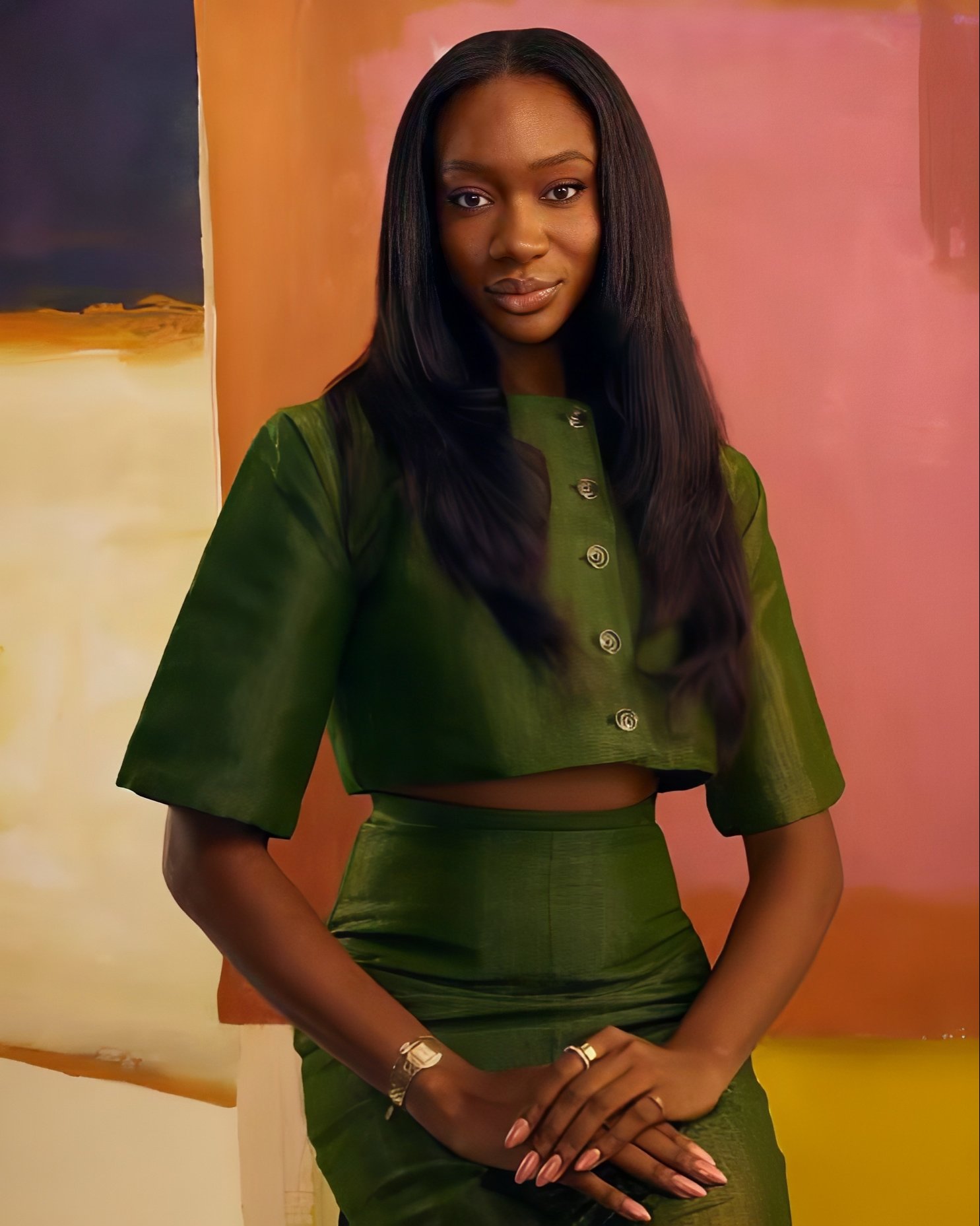
Michelle Adepoju is the founder of Kílẹ̀ńtàr, a company that designs ethical womenswear which blends West African craftsmanship with modern art, empowering women artisans across the continent.
Long before Kílẹ̀ńtàr reached New York Fashion Week, Michelle Adepoju was travelling through West Africa, trying to understand why the region’s rich textile traditions were missing from mainstream fashion.
Although she grew up in a Yoruba household in the UK and studied Art and Marketing before working in PR and marketing, she felt a persistent pull toward something different. That pull eventually led her to spend over a year travelling through Nigeria, Burkina Faso, Côte d’Ivoire and Senegal, where she immersed herself in artisan communities, local textile markets, dye pits, weaving centres and culinary traditions.
The turning point came in Burkina Faso in 2018 while visiting a weaving site. The sight of hand-dyed fabric drying under the sun and the skill of women who had perfected these techniques over generations convinced her that African craftsmanship was beautiful, yet vastly underrepresented on the global stage.
That moment shaped the blueprint for Kílẹ̀ńtàr, the womenswear brand she officially launched in October 2019. The name, taken from the Yoruba phrase “Kílẹ̀ńtà?” meaning “What are you selling?”, shows the vibrancy of Nigerian market culture and the spirit of commerce that binds many West African communities.
Although the brand began as an idea for a marketplace, it quickly evolved into a full fashion label built on handcrafted, ethically produced garments. Michelle Adepoju is now committed to working with artisans across Nigeria, Burkina Faso, Côte d’Ivoire, and Senegal, sourcing handwoven Aso Oke, indigo-dyed Adire, beaded fabrics, patchwork textiles, and naturally dyed materials made with plant and mineral pigments.
The company’s early days were modest as production began with just Adepoju and one seamstress. However, the brand gained traction in 2020 when the Joyo corset top went viral, selling 100 units in a single day. That success enabled her to scale gradually, building relationships with weaving collectives, dyeing clusters and beading cooperatives.
By 2025, Kílẹ̀ńtàr had collaborated with more than 40 artisans across five West African regions. The brand grew even further when it became known for inclusive sizing, offering UK sizes 4–22 with free made-to-measure adjustments, and for its circular approach that repurposes textile scraps into new designs.
In 2024, the creative founder debuted at New York Fashion Week with the Spring-Summer 2025 collection titled “Mama Ìbẹ́ta,” presented by The Green Show in partnership with Mastercard. The collection paid tribute to African femininity and the artisans behind the textiles.
The brand also appeared at London Fashion Week and Lagos Fashion Week, earning Michelle Adepoju features in Forbes 30 Under 30, Essence, and recognition from the British Fashion Council.
Kílẹ̀ńtàr has been worn by prominent Nigerian celebrity models like Temi Otedola, who wore its Awo Set at the recent Business of Fashion (BOF) Gala. The company is estimated to generate approximately $1 million in annual revenue.

Kílẹ̀ńtàr aligns with the UN Sustainable Development Goals focused on gender equality, decent work and responsible production, since most of her partners are women artisans whose livelihoods depend on the survival of traditional crafts.
The business continues to grow through the establishment of retail partnerships, the art of storytelling, and collaboration with a wider range of artisans. Throughout this expansion, the brand remains committed to its mission of enhancing West African craftsmanship, creating jobs, reducing waste, and redefining what “Made in Africa” represents on the global fashion stage.