


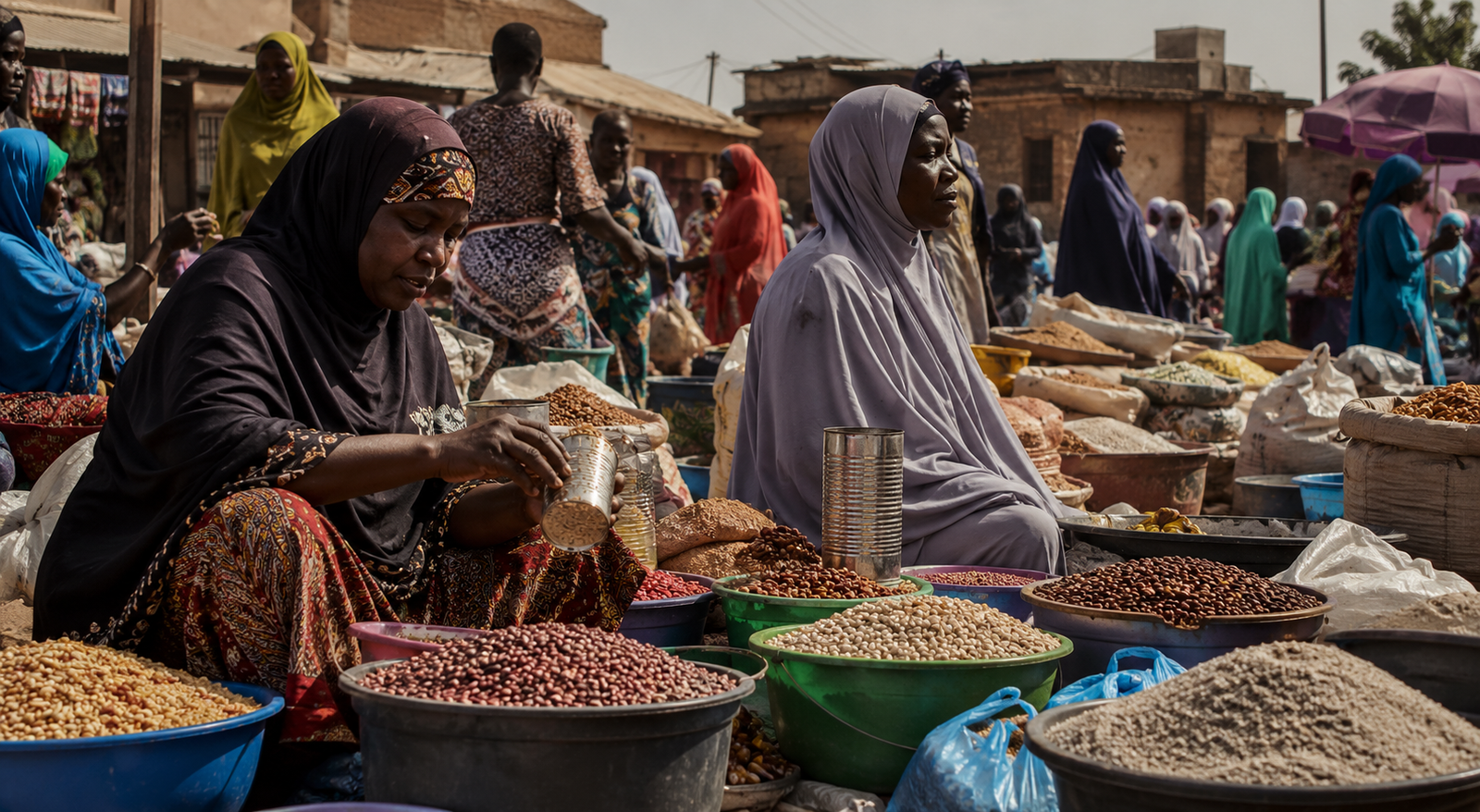
Insecurity disrupts women traders in Northern Nigeria, increasing costs, fear, displacement, and market instability.
(Important notice: Pseudonyms have been used in this article to protect the identities of our sources.)
In Northern Nigeria, women traders start their days not thinking about profits, but about their safety. They ask themselves important questions: Is the road safe? Will the market stay open? Will they make it home?
In states like Borno, Katsina, Zamfara, Yobe, and parts of Kaduna, insecurity has become a constant worry, affecting daily life and business.
A struggling market
Northern Nigeria has had lively informal markets, with women playing crucial roles by selling food and other goods. However, insecurity from banditry and kidnappings has severely disrupted these markets, especially since 2011, when regions like Zamfara, Katsina, Kaduna, Niger and Sokoto states recorded intense banditry attacks, thus escalating insecurity in Nigeria alongside terrorism. This issue actually traces back to the 1930s, when attacks on trade routes were reported.
Markets that used to be busy now operate on reduced hours or close unexpectedly, depending on the day’s security. Amina Aliyu, a store owner from Katsina, sums it up: “You don’t plan your business week anymore. You plan your survival.”
Survival over growth.
Displacement is one of the worst effects of insecurity, forcing communities to leave their homes and often leaving women traders to start all over with limited or no resources. Many have lost their shops and inventory and must now sell small items in unfamiliar locations, prioritising survival over growth.
For many women, moving around is essential for their business. They need to find goods and reach customers, but travelling has become risky. Roads are often unsafe, limiting their travel distances or forcing them to rely on middlemen, which cuts into their profits. Some must travel only at certain times or in groups, which restricts their ability to respond quickly to market needs.
In a telephone conversation, Fausa Ahmed, a trader from Zamfara State, shares that she remodels her business into survival mode after a bandit attack in the State that killed at least 18 people in Bunkasau and surrounding villages in the Bukkuyum Local Government Area, and a further 22 people in Tungar Kwana village, Talata-Mafara LGA of the state.
“There comes a point where you have to decide what is best for you and your family. Given the current situation, I had to adapt. To survive, I changed my business from textiles to food, and now I take orders through social media to reduce the risks associated with travel,” she explains.
Increased costs, lower profits and emotional toll.
Insecurity has increased the cost of doing business for women traders. Higher transport fares, informal payments for safety, and losses from delayed or missing goods all cut into already slim profits. At the same time, fewer customers are coming to the markets, making sales even more difficult. As one Bola Oke, a businesswoman in the Sabongida area of Kano State, puts it, “Even when you sell everything, you’re still not sure you’ve made a profit.” Oke used to travel down to Aba, Abia State (Eastern Nigeria) twice a month to import quality shoes and female wear.
“I used to make between ₦800,000 and ₦1.2 million a month, but that’s no longer the reality,” she says. “I have to think about staying alive for my family. Relocating isn’t an option for me either- my family has lived here for three generations. My husband is also here, so this is home,” Oke explains.
The pressure is not only financial but also emotional. Many women traders in Northern Nigeria live with constant fear of attacks on the road or in markets, alongside worries about their families’ safety and unstable incomes. For those who are also caregivers, the strain is even heavier.
While everyone is affected by insecurity, women bear a heavier burden. They often depend on informal trade, which limits their opportunities, face obstacles in accessing credit, and carry added responsibilities at home.