


Bukola Peter-Chukwusah champions AI-driven education reform to prepare Africa’s youth for future work.
Since the beginning of the decade, the world has experienced a series of disruptions that have reshaped how people interact with their environment. Chief among them was the COVID-19 pandemic, which accelerated the global shift to a digital economy and triggered further technological changes.
From 2020 onward, technology became a major driver of disruption, with increased adoption of digital platforms across sectors such as health, finance, commerce, education, and entertainment. These tools enabled remote activities and reduced exposure to the virus during lockdowns that lasted nearly a year in many parts of the world. The World Economic Forum reported that the lockdown led to 114 million job losses globally in 2020 alone. In Nigeria, 20 per cent of the full-time workforce lost employment during the same period.
As the world gradually adjusted to post-pandemic realities, another wave of uncertainty emerged with the growing prominence of Artificial Intelligence (AI). Fears spread across the global workforce as many speculated that AI would threaten their jobs. Beyond employment, concerns extended to potential losses of purpose, identity, and social belonging. The World Economic Forum’s Future of Jobs Report 2025 indicates that 41 per cent of employers plan to reduce their workforce by 2030 due to AI-driven automation. But Bukola Peter-Chukwusah, an AI Automation specialist, who is one of Africa’s brightest minds, is working to reduce this number from the grassroots level.
Bukola ‘Gbemi’ Peter-Chukwusah is an Entrepreneur, AI Automation specialist, community advocate and public speaker bridging Africa’s digital divide. As the co-Founder of NEXT, she is democratising high-end technology education through NEXT FutureLab: a high-octane ‘tech-engine’ delivering AI Engineering, Robotics, and Coding to semi-rural schools, guided by the philosophy of ‘no child left behind’.
Peter-Chukwusah is a TechWomen Nigeria Fellow, an Orange Corners Alumni, Digital Ambassador for the African Development Bank and Microsoft; she seamlessly merges global policy with grassroots impact to turn potential into a powerhouse of innovation.
In this conversation with The Benchmark, she shares her thoughts about AI and the Future of work in Africa.
Do you think Africa has what it takes to meet the demands of the future of work and innovation, and how does AI adoption help to bridge the gap?
Africa possesses the two most critical ingredients for the future of work: Youth and Adaptability. However, there is a “readiness gap” that AI adoption is uniquely positioned to close. Through NEXT, we have seen that when you introduce AI tools to students in underserved areas, their adoption rates are astronomical because they have a “hunger for the future.” AI adoption bridges the gap by providing low-cost, high-impact tools that allow a small school in a semi-rural community to manage data like a multinational institution. With over 7,500 students already on our portal, we are proving that Africa doesn’t just have what it takes—we are already building it.
Through NEXT, underserved students are equipped for the AI and digital revolution and have the same access to future-skills as a child in a tech-hub city. Beyond the classroom, Next is digitising the very backbone of these institutions with the NEXT School Admin Portal, transforming underserved schools into globally competitive, operationally efficient hubs.
Africa has the largest growing young population in the world. How is/will AI impact the future of work and education in Africa?
For Africa, AI is a “Master Leapfrog” tool that Africa needs to take advantage of and drive policies in education. Particularly in the semi-rural communities where NEXT FutureLab operates, AI acts as a “force multiplier” for teachers. Where there is a shortage of specialised instructors in advanced subjects, AI-powered adaptive learning platforms can provide personalised tutoring for students. In the world of work, AI is shifting the African narrative from “manual labour” to “intellectual exports.” By training our students and youths in AI Engineering today, we are ensuring they aren’t just consumers of global tech but the architects of localised AI solutions that solve African problems, from Education to Agritech.
What earliest life experience informed the part you have chosen today?
Growing up, I was an active grassroots community mobilizer and was also involved in mentoring youths within African communities. So, I have seen a massive gap where brilliant minds in semi-rural areas were being sidelined simply because they lacked “Information Management”. This informed my realisation that the “Japa” wave isn’t just a move of people, but a drain of potential caused by a lack of local infrastructure. This drove my vision to build NEXT FutureLab: a high-octane ‘tech-engine’ delivering AI Engineering, Robotics, and Coding to semi-rural schools, guided by the philosophy of ‘no child left behind’. It is a STEM infrastructure and Systems we have built in Africa so that talent can thrive where it is born.
Tell us a bit about your upcoming event and what you hope to achieve.
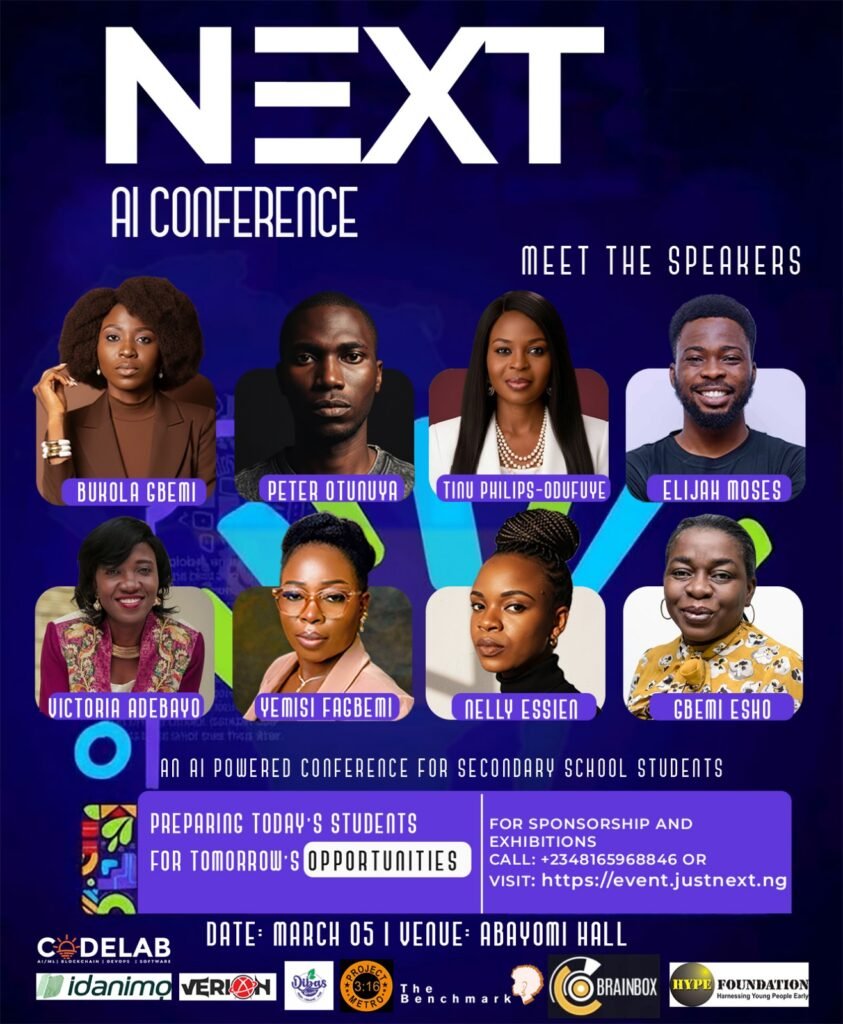
We are currently organising the NEXT AI Conference, a landmark event designed to ignite a digital transformation in Nigeria’s semi-rural corridors. Bringing together 50 schools and 300 participants, including students and school owners, to explore the practical applications of AI in education and administration. Our goal is to move the conversation from “fear of AI” to “AI for Empowerment.”
The event will be held on the 5th of March, 2026, at Abayomi Event Centre, Mechanic B/Stop Oregie, Ajegunle-Apapa, Lagos, Nigeria.
By the end of this conference, we hope to have empowered 50 school owners with the digital tools to automate their administration and inspired 300 students to see themselves as future AI engineers. This isn’t just an event; it is the launchpad for a new era of Inclusive Excellence in Nigerian education.
Click the following link to learn more about the NEXT AI Conference.